What makes it different
A field you can shape without breaking it.
Encoding is solved several times over. Moulding a field once it exists is not.
Encoding is solved several times over. Moulding a field once it exists is not.
Ambisonic suites are, overwhelmingly, about getting audio into the format and back out of it. Encode, rotate, decode. Once a field exists, the tools available treat it as a single object: turn it up, turn it down, blur it, rotate it.
That is fine if a sound field is a delivery format. It is not enough if it is a thing you are trying to compose with. What was missing was a way to make something close or far, enveloping or pin-sharp, present in a room or heard through a wall — and to move those qualities over a timeline the way a scene demands.
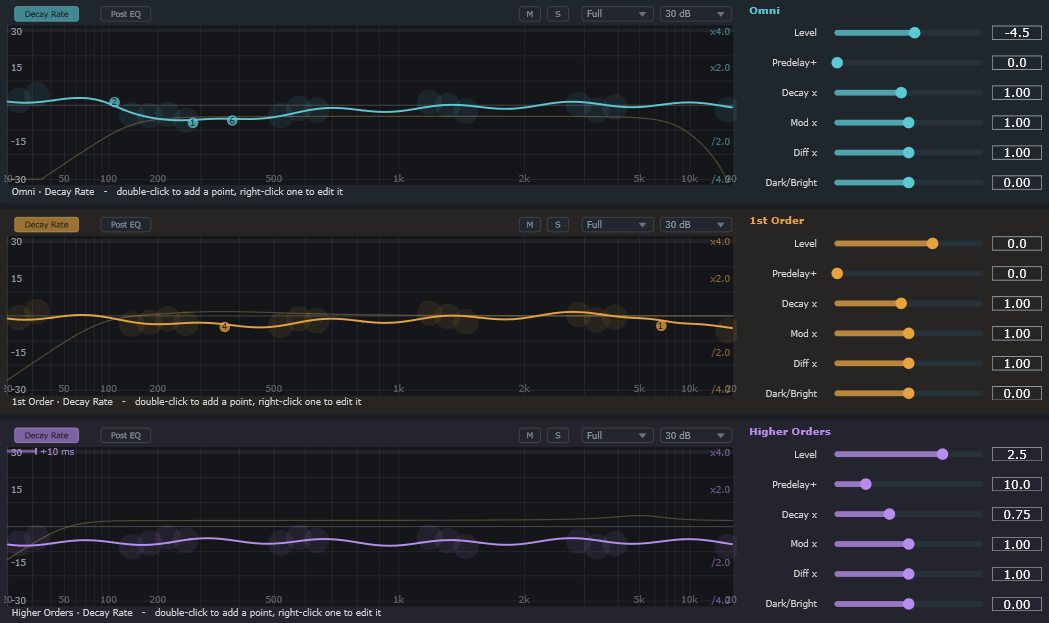
This is the centre of the design and the thing everything else follows from. The suite treats the ambisonic channels as three groups by spatial detail, and lets you work on them independently.
The bed. Body and weight, with no direction of its own.
Broad direction. Roughly where things are.
Precision. Exactly where, and how sharply.
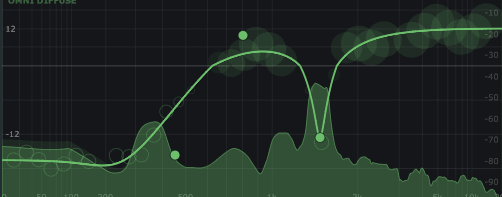
A conventional EQ has one axis: frequency. The spatial EQ here has two, frequency and spatial detail, and every point you place lives at an intersection of both. Take 2 kHz out of the directional content and leave the omnidirectional bed intact: the mix keeps its body and loses its edge. Lift the higher orders in the presence band and everything is more precisely placed without getting louder.
The point is not the effect list. It is that these are operations on the structure of the field, expressed in the format's own terms — so the field stays coherent and decodable afterwards. Every tier-aware plugin uses the same three groups in the same colours, so a distinction learned in one place reads correctly everywhere else.
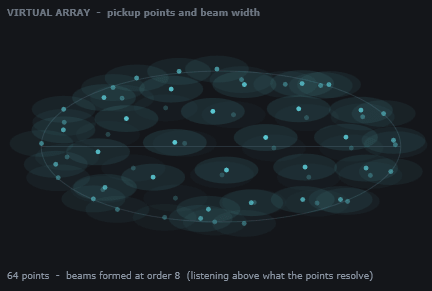
The suite runs to 10th order — 121 channels — in CLAP, and 7th in VST3, where the ceiling is structural: the channel-layout field is 64 bits wide.
Going past 7th is not about a bigger number on a specification. It is that the suite gives you tools to shape those orders separately, so the extra detail is material you can work with rather than overhead you carry. Per-order gain corrects the fact that higher orders are quieter by nature — an order that is genuinely clearer than its neighbours can still be the quietest thing in the field, and there is otherwise no way to fix that without also changing the frequency response.
Without the means to mould them, order 10 is just a bigger bill.
Wherever a parameter’s effect can be drawn, it is drawn. This is a teaching position as much as an aesthetic one. Ambisonics is notoriously hard to build intuitions about: the channels are unlistenable in isolation and ordinary meters say nothing about direction. If a control’s effect is visible, you learn what it does by using it.
The manuals follow the same rule from the other side. Their parameter reference is harvested from the plugins’ own tooltips, so the manual and the interface cannot disagree, and their figures are rendered by the plugins’ own drawing code, so those cannot drift either.
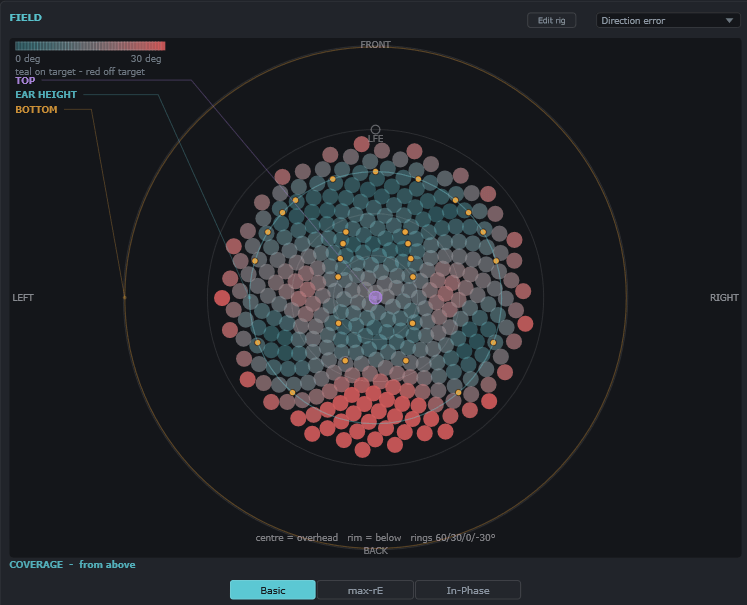
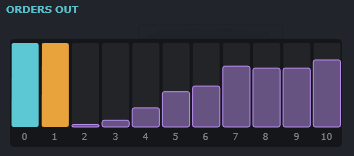
Working this way forced new visualisation. If you can shape three tiers independently, you need to see them independently — a single energy map cannot show you that the higher orders disagree with the bed, and a level meter cannot show you which order is carrying the detail.
Nothing available answered those questions, so I designed displays that do: three kinds of field view showing what is happening at every order rather than only in aggregate, and a per-order meter that reads the whole field at a glance.
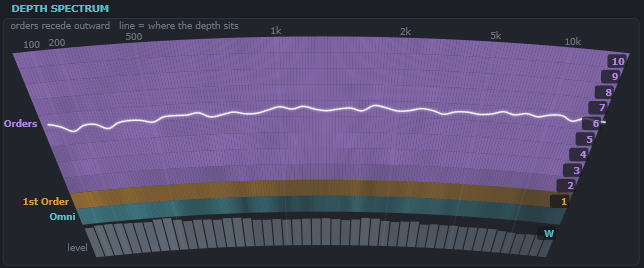
Image-source reflections with per-surface materials, ISO air absorption, honest distance laws — as the starting point, not the law. A tool for drama has to let you lie convincingly, and accurate physics is what makes the lie convincing.
The counterweight is measurement. Every plugin carries a render fence: fixed cases rendered to a hash, with baselines committed alongside the source. A change that alters the audio shows up immediately and has to be justified; a change that should be inaudible has to prove it is bit-identical. Several real bugs here were caught by a fence case written before anyone noticed a symptom.
The trade-offs are deliberate, and they are measured rather than asserted.