Kuules suite
Birds
a robin is a tuned tract; a crow is not
a robin is a tuned tract; a crow is not
A bird's syllable is two slow gestures — the air-sac pressure and the syrinx's tension — driving a pair of oscillating membranes, then a vocal tract the songbirds tune to their pitch. That is the physics (Mindlin & Laje), and it is why a thrush is a near-pure tone and a crow is a rasp. Kuules Birds sings that way: every syllable a pitch gesture and an amplitude gesture into a source whose harmonics rise with the drive and a tract that tracks the note; every song composed for its kind, in bouts, with pauses, answered by a neighbour.
Twelve kinds, placed. Songbird, blackbird, robin, wren, chaffinch, great tit, cuckoo, pigeon, crow, gull, owl, sparrows — up to eight on the map, each with a flock scattered round its place. They fly. A flight is a burst of wingbeats at the rate the bird's mass sets, then a glide, and the bird moves across the map while it does. They answer. Countersinging: a song is picked up by another of its kind a second or three later.
Each kind has its own tuned saturator: harmonics that grow as the bird sings out, a robin staying nearly pure, a crow rich and rasping. Notes glide onto their pitch and slur into each other; nothing is perfectly steady. Glide, Harmonics and Jitter scale them all.
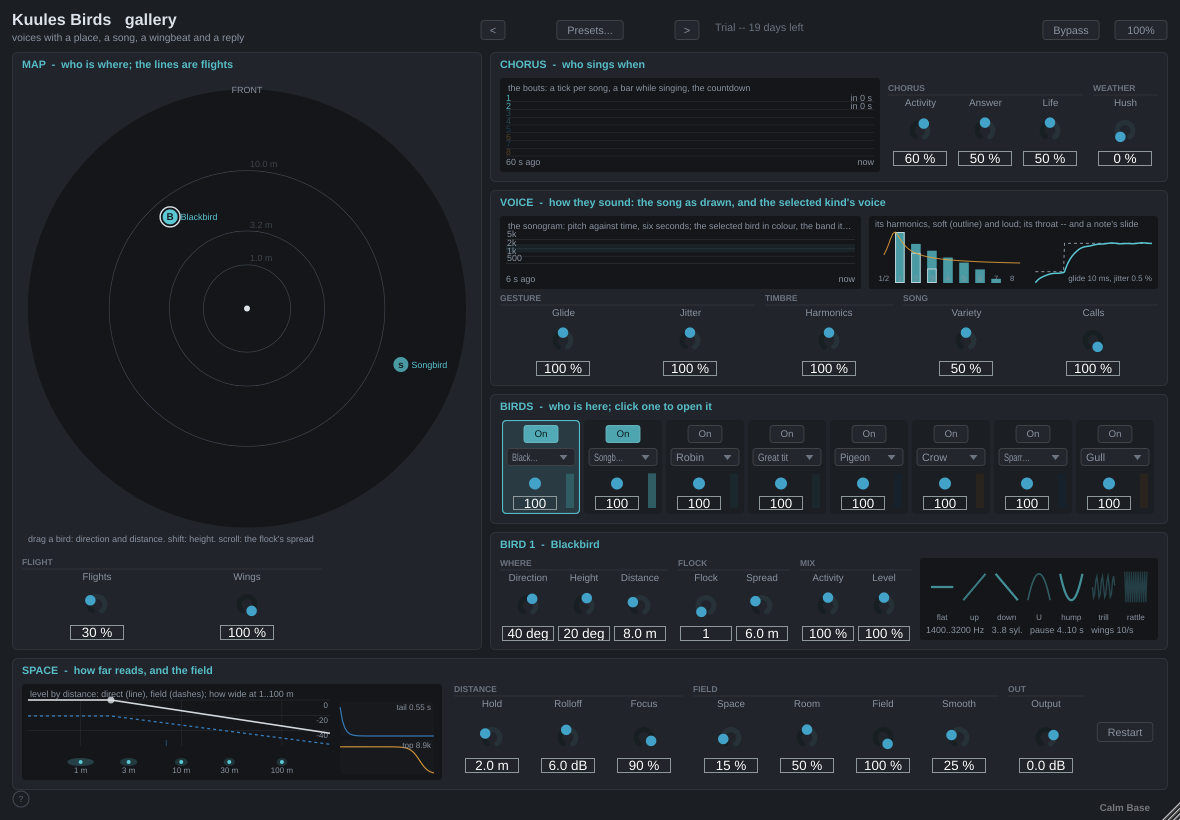
Six seconds of every voice, pitch against time, the way a field guide draws a song — sweeps as slopes, trills as zigzags, a caw as a smear.
A minute of song starts per bird, a bar while it sings, the countdown to the next. Activity is the dawn chorus; Hush is the wind and rain.
Its range, the shapes its syllables take and how often, how long a syllable and a song are, how pure the voice, its wingbeat.
Dawn chorus, noon, dusk, night, a harbour, a town square, a rookery, a hedge of sparrows, one blackbird, a cuckoo across the valley, a storm coming.
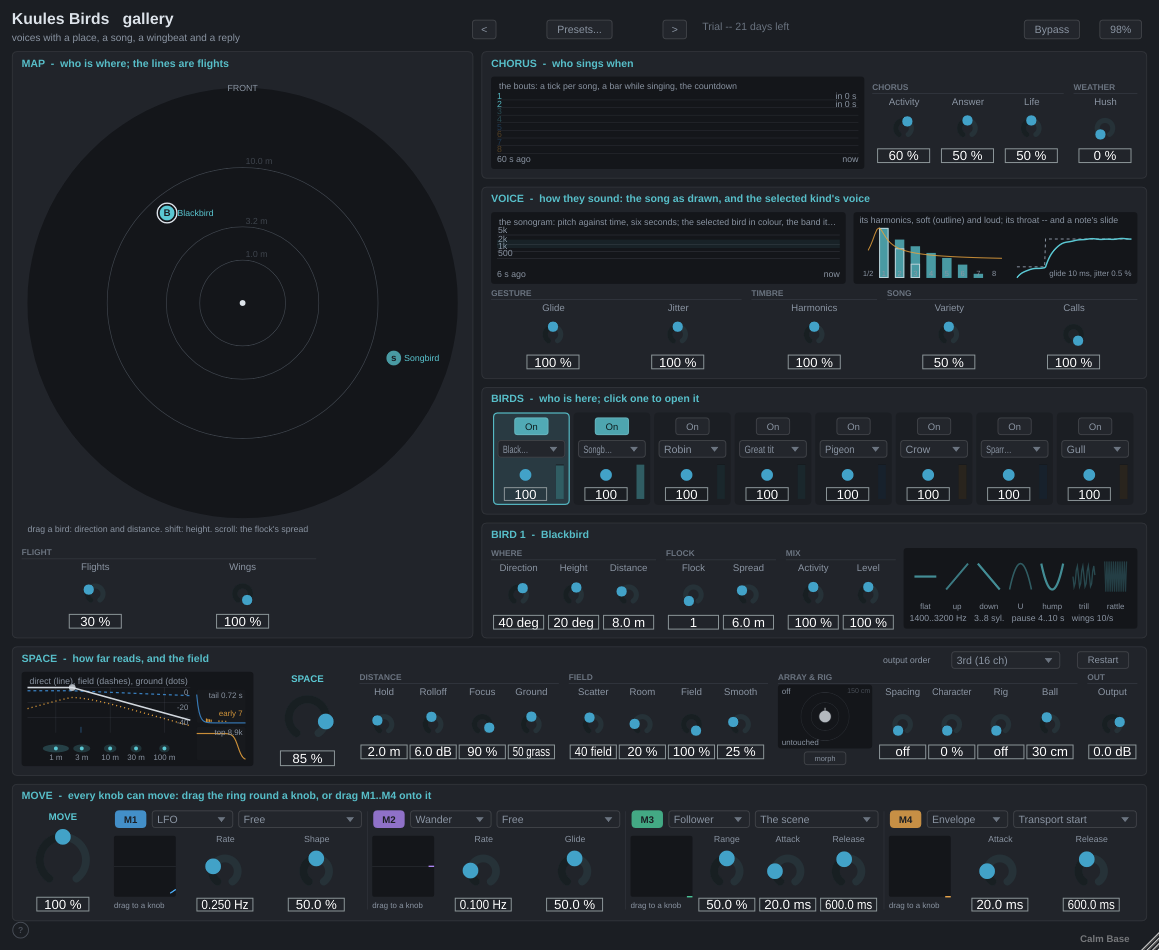
A ring round every knob: drag it, and the knob moves — by an LFO, a wandering drift, a follower of the track or of the scene itself, or an envelope. Four movers, a trace of each, and one MOVE knob for all of it. The knob stays where you set it; the ring shows the movement round it.
Spacing gives the scene a spaced pair's width — the low end of the ambience opens up, and every source gets a little more ITD — without moving a single direction (measured: 0.0 degrees at every octave). From 0 (off, the scene untouched) to 150 cm; Character adds the spaced capsules' own comb colour to the ambience only. Drawn from above, capsules and all.
Rig blends a dense sphere of omnis on a rigid ball — the rig you would build with 121 capsules round a baffle, stamped per capsule — into the sharp field: its time structure and shading in every direction and every order, with no comb and no aliasing, and the direction of every source untouched (measured). 0 is off; Ball sets its size (30 cm by default); Sum mixes the two, Morph blends a fraction of the ball's character. Drawn round the head, to scale.
Wide things are wide: a crown of leaves, a bonfire, a brook are many independent sounds across their width, not one blurred one — so a low-Space scene stays out in the world. Under every raised source, the ground's reflection (Ground: none, grass, stone). A few early reflections off what is round you, more and nearer with Scatter. And a cleaner field: dense from the first millisecond, no metallic ring, no rumble piling up when Room is up.