Kuules
Dynamics
dynamics for the field, the image held still
dynamics for the field, the image held still
Compress, gate or shape the attacks of an ambisonic bus with an ordinary tool and the image moves. Dynamics does all three to the field and keeps every source where it was.
Kuules Dynamics is three tools on one engine, a switch at the top: Compress levels the field, Gate closes it between sounds, Transients sharpens the hits and leaves the air. Each works in lanes — the omni, the first order, the higher orders — or on every direction on its own, and each keeps its own settings while you try the others.
Fenced, not hoped. Every build is tested: a source in front stays in front; the rear null stays a null. A 1 ms attack means 1 ms at any buffer size.
Threshold, ratio and knee for the body of the field and for its detail, separately — or level the loud directions and lift the quiet ones.
How far it closes, per lane; or sink the room between sources, only in the directions with nothing in them.
Shaped per lane, with the detector on screen: the fast follower, the slow one, the gap that counts as an onset.
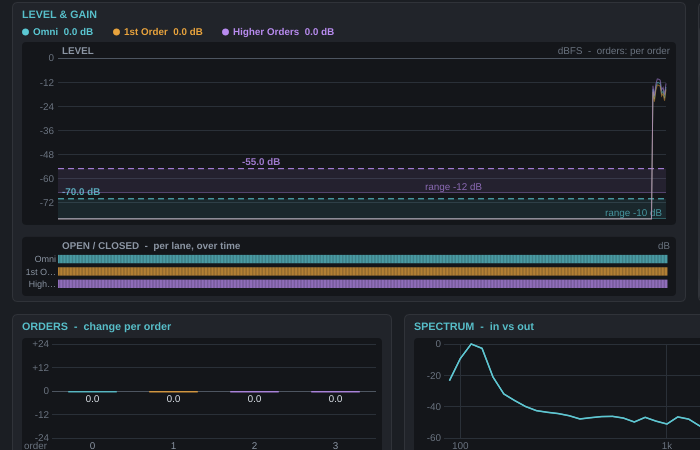
Thresholds are lines on the level graph. Drag them.
Mono, stereo or a whole ambisonic field, riding on the same track and cleared on the way out.
121 channels in CLAP, up to 7th order in VST3, ambiX (ACN/SN3D) throughout.
Move any control from your own controller; one knob can drive several, each with its own range.
Fixed cases rendered and compared on every build, so a change that should be silent is proven silent.