Kuules suite
Fire
the crackle is the wood, not the flame
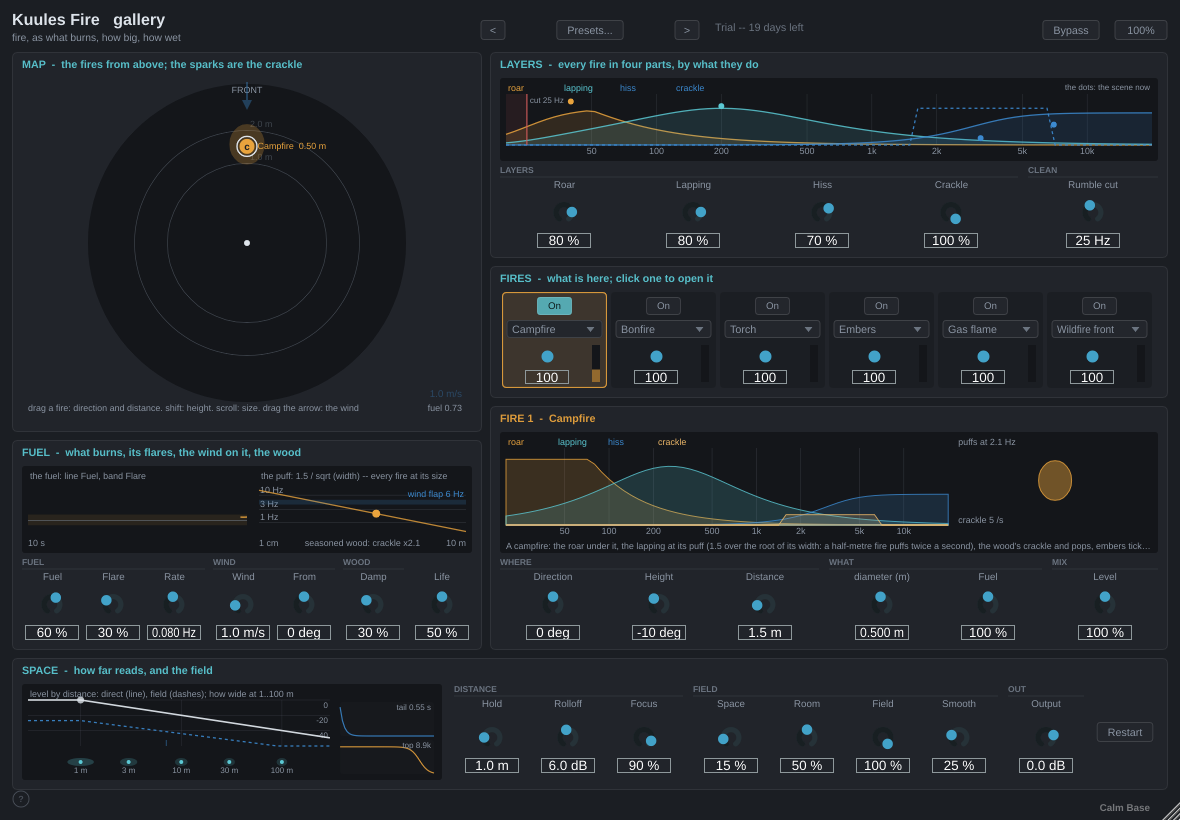
the crackle is the wood, not the flame
A flame is a monopole: the air expanding as the heat is released, a roar whose spectrum falls as the five-halves power of frequency above a low peak. That peak is the fire's PUFF — a buoyant flame breathes at 1.5 over the square root of its width, so a half-metre campfire laps twice a second and a bonfire once. In wind it flaps at five to fifteen hertz instead. Kuules Fire is built on those laws (Chadwick & James; Cetegen & Ahmed), and on the fact the papers leave out: the crackle is not the flame, it is the wood — steam and sap bursting, in clusters, three times as much when the wood is wet.
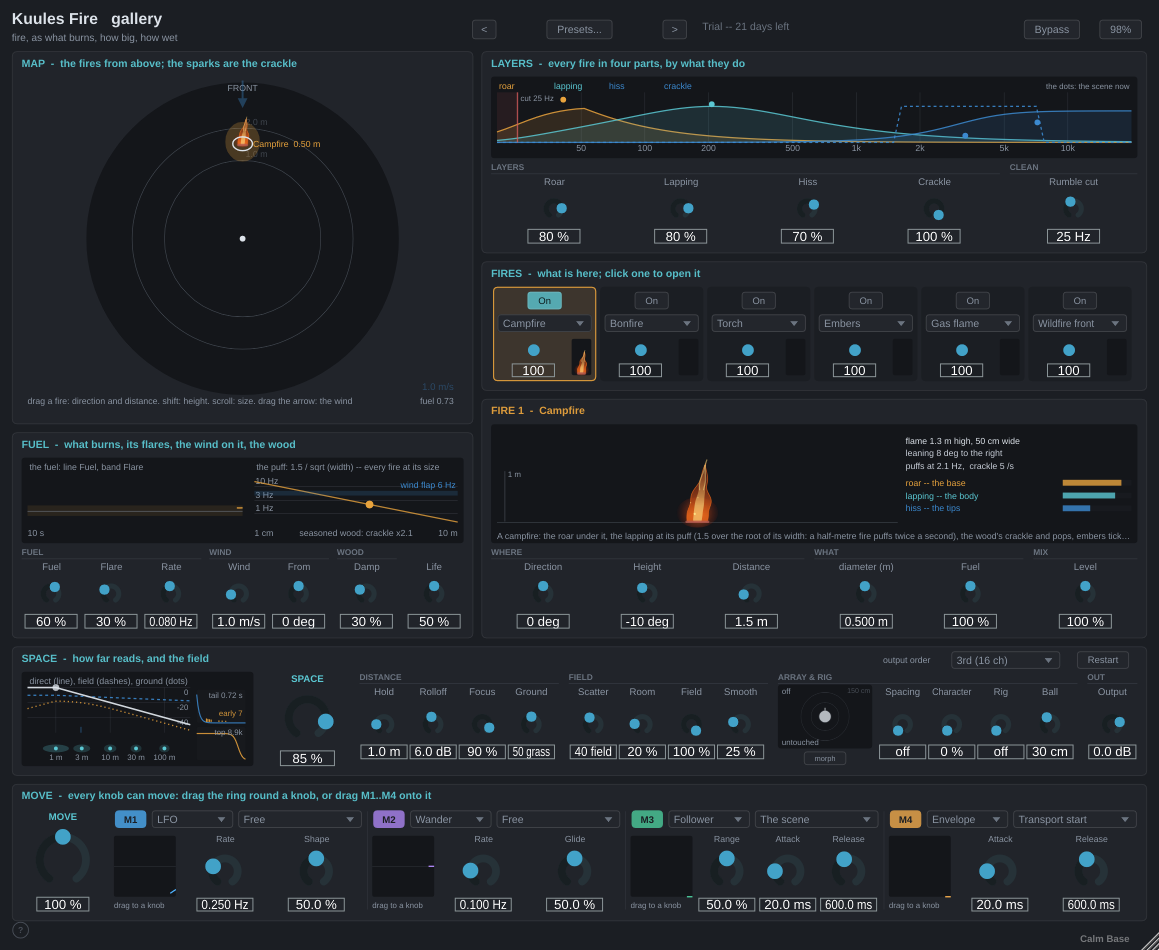
Eight kinds of fire, placed. A candle, a campfire, a bonfire, a hearth, a torch, a gas flame, embers, a wildfire front — up to six on the map, each with its size and its share of one fuel. One fuel, one wind, one dampness. Fuel flares like a log catching and settling; the wind feeds the fires on its gusts, flaps them and leans them; Damp is the wood.
Roar (the monopole), lapping (the body, breathing at the puff), hiss (the jet, the steam, the wind), crackle (the wood) — each with its law, drawn over frequency.
Every fire has a shape: as tall as what is burning, leaning away from the wind, swaying. The roar sits at its base, the lapping in its body, the hiss at its tips — so the base holds still and the tips wander, in the sound as in the drawing of the fire you have open.
The 1.5-over-root-width law with every fire on it as a dot at its size; the selected fire pulsing beside its layers.
Every crackle and pop is an event with a place; on the map they fly up and fade.
A campfire, wet wood, a bonfire, a hearth, dying down, a torch in the wind, torches round a hall, a gas ring, candles, a wildfire on the ridge, a camp at night.
A ring round every knob: drag it, and the knob moves — by an LFO, a wandering drift, a follower of the track or of the scene itself, or an envelope. Four movers, a trace of each, and one MOVE knob for all of it. The knob stays where you set it; the ring shows the movement round it.
Spacing gives the scene a spaced pair's width — the low end of the ambience opens up, and every source gets a little more ITD — without moving a single direction (measured: 0.0 degrees at every octave). From 0 (off, the scene untouched) to 150 cm; Character adds the spaced capsules' own comb colour to the ambience only. Drawn from above, capsules and all.
Rig blends a dense sphere of omnis on a rigid ball — the rig you would build with 121 capsules round a baffle, stamped per capsule — into the sharp field: its time structure and shading in every direction and every order, with no comb and no aliasing, and the direction of every source untouched (measured). 0 is off; Ball sets its size (30 cm by default); Sum mixes the two, Morph blends a fraction of the ball's character. Drawn round the head, to scale.
Wide things are wide: a crown of leaves, a bonfire, a brook are many independent sounds across their width, not one blurred one — so a low-Space scene stays out in the world. Under every raised source, the ground's reflection (Ground: none, grass, stone). A few early reflections off what is round you, more and nearer with Scatter. And a cleaner field: dense from the first millisecond, no metallic ring, no rumble piling up when Room is up.