Kuules suite
Prism
an equaliser with a second axis
an equaliser with a second axis
Prism is a spatial EQ. An ordinary equaliser has one axis — frequency. Prism has two: frequency and space, and every point you place sits at an intersection of the two.
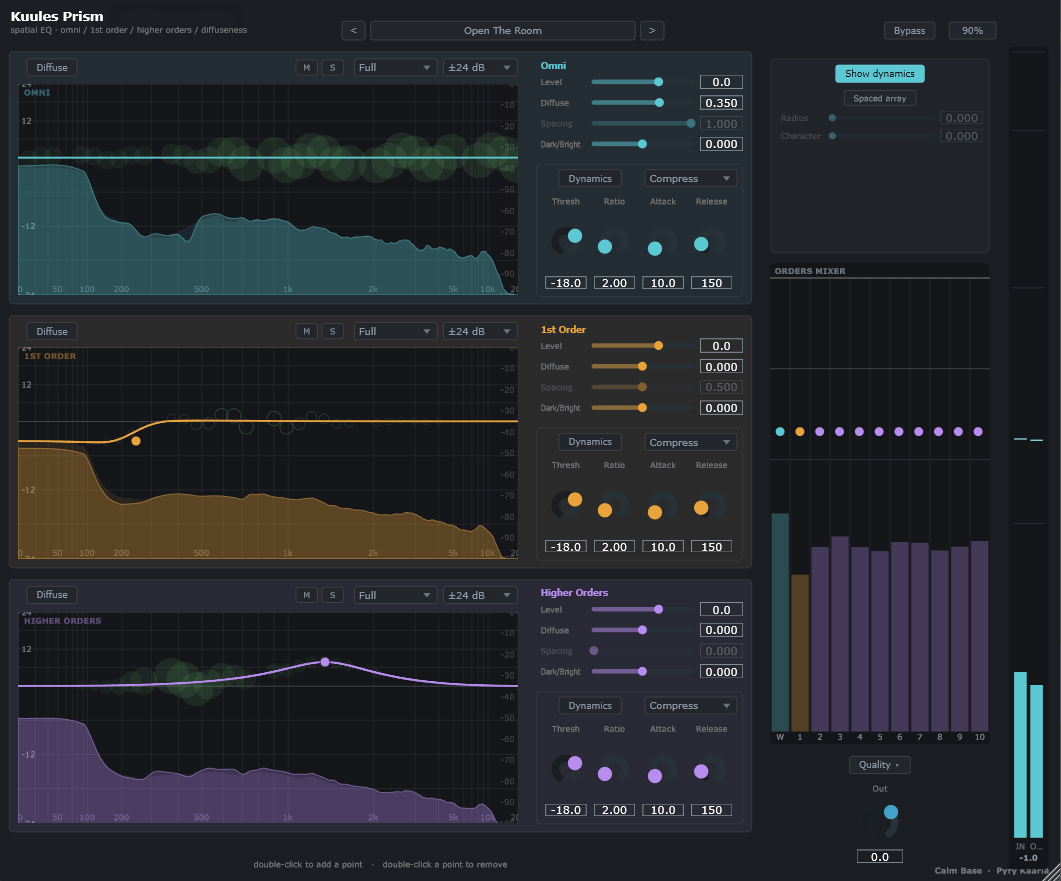
The spatial axis is three tiers. Omni is the spectrally balanced sound with no direction at all. 1st Order is the smeared body of the directional sound. Higher Orders are its increasing presence and clarity.
Take the edge off the sharply placed part and leave the body of the field alone, brighten the undirected bed without brightening the sources standing in it, or diffuse the omni while keeping the sources sharp. Points can also be aimed at a direction, and every band is dynamic, compressing or expanding to suit the material — but the two axes are what make it a different instrument. No frequency-only equaliser can do any of it, at any setting.
Each one aimed at a frequency and at a degree of spatial detail. A point on the directional tiers can be pointed at a direction too.
Every band can compress or expand to suit the material, not only cut or boost.
Hear the omni bed, the first-order body or the higher orders on their own.
Give the field a spaced pair's width — an opened low end and a little more ITD — without moving any direction (measured), the spaced capsules' comb colour on the ambience only. Sessions made with the old array open as they were.
Rig blends a dense sphere of omnis on a rigid ball — the rig you would build with 121 capsules round a baffle, stamped per capsule — into the sharp field: its time structure and shading in every direction and every order, with no comb and no aliasing, and the direction of every source untouched (measured). 0 is off; Ball sets its size (30 cm by default); Sum mixes the two, Morph blends a fraction of the ball's character. Drawn round the head, to scale.