Kuules
Underwater
the surface is the biggest change a listener can hear
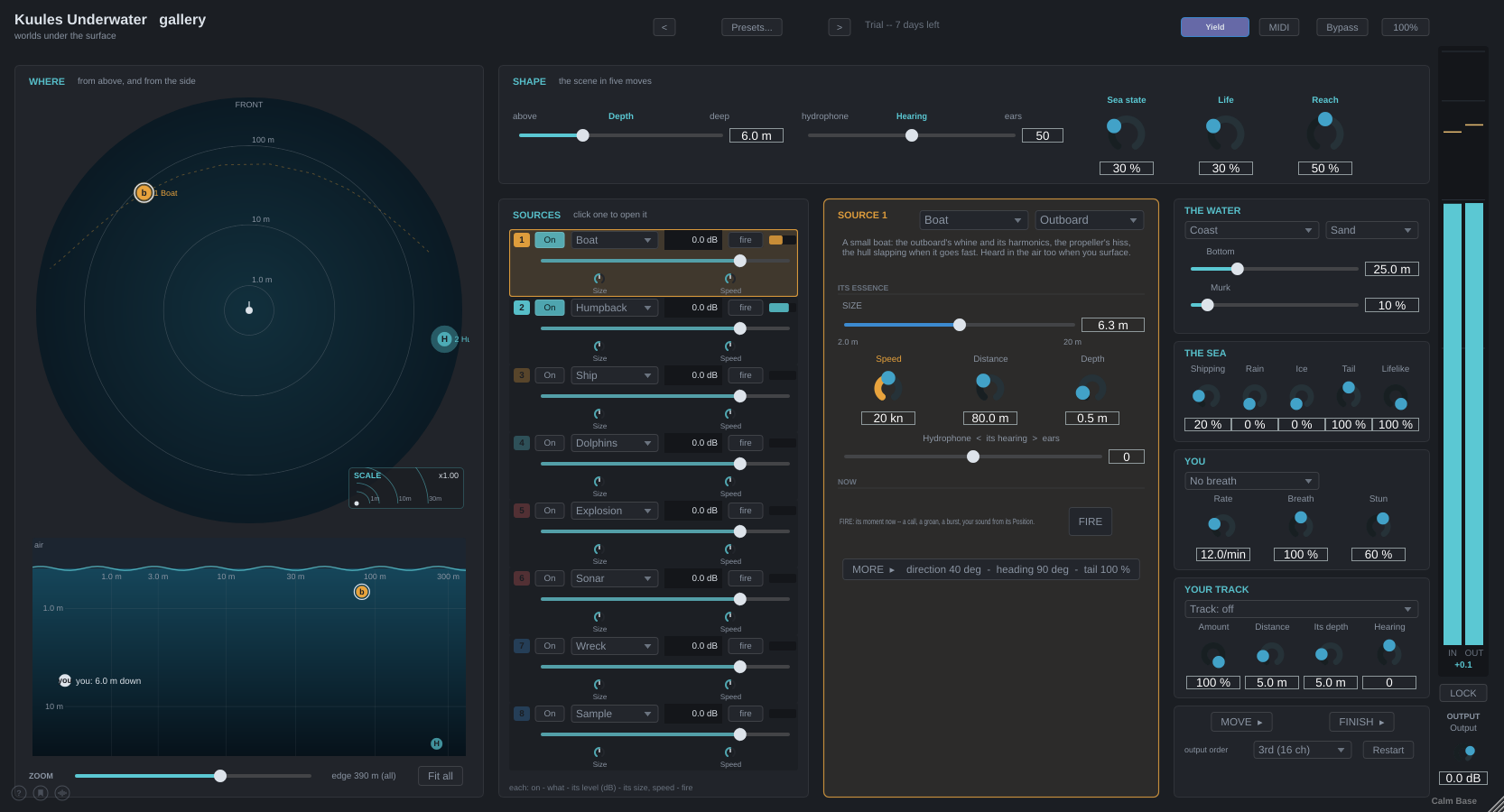
the surface is the biggest change a listener can hear
Going under the water is one of the biggest changes a listener can hear, in a game or on screen. Underwater builds the world below the surface, and the crossing between above and below.
Kuules Underwater builds the water — its depth, its bottom, how murky — and the sea above it: its state, rain, shipping, life and ice. In it, up to eight sources: ships, boats, a submarine, humpback, blue and sperm whales, dolphins, orca, a fish chorus, explosions, sonar, a wreck, a vent, or your own sound as grains.
You choose how it is heard. Through a hydrophone, the way a game plays it, or with a diver's ears, and at what depth — the listener can cross the surface. Your track can be taken into the water, or heard from above it. A close blast can stun.
Each placed at its depth, with its size and speed in its kind's own units.
From a hydrophone to human ears, with a diver's breathing if you want it.
What is already on the track, taken into the scene or heard from above the surface.
Explosions, calls and sonar from the window, or from MIDI notes with velocity.
121 channels in CLAP, up to 7th order in VST3, ambiX (ACN/SN3D) throughout.
A ring round every knob: drag it and the knob moves — by an LFO, a wandering drift, a follower of the track or an envelope. The knob stays where you set it; the ring shows the movement round it.
Move any control from your own controller; one knob can drive several, each with its own range.
Fixed cases rendered and compared on every build, so a change that should be silent is proven silent.