Kuules suite
Weather
weather, from nothing, anywhere
weather, from nothing, anywhere
Kuules Weather builds a setting, not a sound: air, water, rain, fire, ether and birds running together, each placed on the map, driven by three macros — wind speed, precipitation, life. Not from recordings, from models.
Nothing stays as it is. One knob, Life: every layer breathes, the bands wander, the whistles drift. Depth is the point. Rain from half a metre to three hundred; a storm far off and nothing close; rain around you but not on you. And the distance is yours to stylise: where the level holds, how fast it falls, how big each source is, and where the scene is — in the open, where far things stay small and sharp, or enclosed, where they dissolve into the field.
Whistles whose pitch follows the wind speed. Drops that ring with the surface they hit. Bubbles that rise in pitch. Flames that lap. A cloud of ringing voices over a drone. Birds that flap, glide and call — pigeons, songbirds, gulls, crows — no two calls the same.
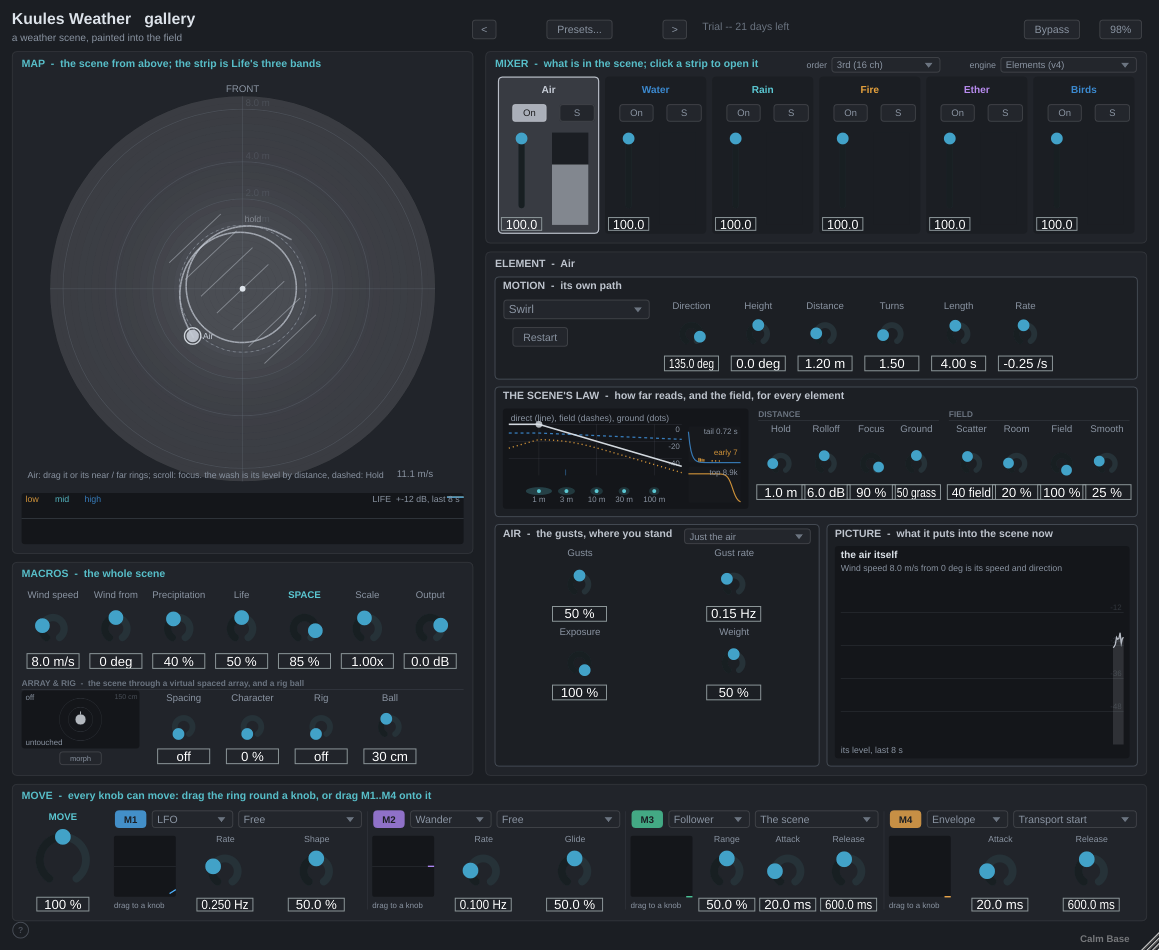
A strip per element — on, solo, a fader and its level. Open a strip and everything about that element is there: its own motion, its knobs and a picture of what they do.
The same six engines as Kuules Wind, Rain, Water, Fire, Ether and Birds, running as one scene under one distance law and one field: pick what kind of water, what kind of fire, which birds, and where the wind comes from. Sessions made before it open on the Classic engine and sound exactly as they did.
Pink noise in three breathing bands — weight, body, breath — and for rain and water, thousands of tiny drops and bubbles a second instead of noise.
Moving bells on every layer, low, mid and high; layers that swell and fade; drops that come in waves. Seen on the strip under the map.
Swirl, drift, orbit, or draw the path on the map — streamlined, or snapped to a circle, spiral or polygon.
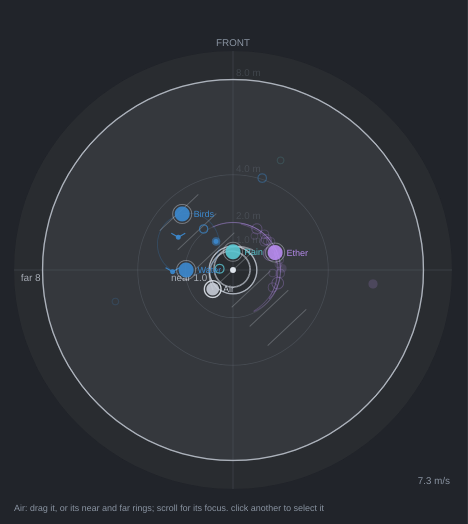
Where the sounds live and how far reads, drawn: the direct and the field against distance, the band the drops live in, how wide the source is — drag any of it. Near things fill the angle they take up and carry the bass of a close wavefront; far things are points. Open, the field is the ground and the trees — as dense as you say, from clear air to a forest; enclosed, it is the room. The same law as Kuules Scene, so a weather scene inside a Scene room agrees with it. Up to 10th order.
What the rain lands on, by weight: water, leaves, metal, wood, stone, grass. And Smooth on every element, from crackle to hush.
The wind has a speed; the water a flow, the rain its squalls, the fire its fuel, the ether a tide, the birds their shelter. One quantity each, and everything in the element hangs off it — level, pitch, body, events — so a gust, a surge or a flare changes the character, not the volume. Each drawn live under its picture.
A ring round every knob: drag it, and the knob moves — by an LFO, a wandering drift, a follower of the track or of the scene itself, or an envelope. Four movers, a trace of each, and one MOVE knob for all of it. The knob stays where you set it; the ring shows the movement round it.
Spacing gives the scene a spaced pair's width — the low end of the ambience opens up, and every source gets a little more ITD — without moving a single direction (measured: 0.0 degrees at every octave). From 0 (off, the scene untouched) to 150 cm; Character adds the spaced capsules' own comb colour to the ambience only. Drawn from above, capsules and all.
Rig blends a dense sphere of omnis on a rigid ball — the rig you would build with 121 capsules round a baffle, stamped per capsule — into the sharp field: its time structure and shading in every direction and every order, with no comb and no aliasing, and the direction of every source untouched (measured). 0 is off; Ball sets its size (30 cm by default); Sum mixes the two, Morph blends a fraction of the ball's character. Drawn round the head, to scale.
Wide things are wide: a crown of leaves, a bonfire, a brook are many independent sounds across their width, not one blurred one — so a low-Space scene stays out in the world. Under every raised source, the ground's reflection (Ground: none, grass, stone). A few early reflections off what is round you, more and nearer with Scatter. And a cleaner field: dense from the first millisecond, no metallic ring, no rumble piling up when Room is up.