Kuules suite
Wind
grass on one side, bamboo on the other
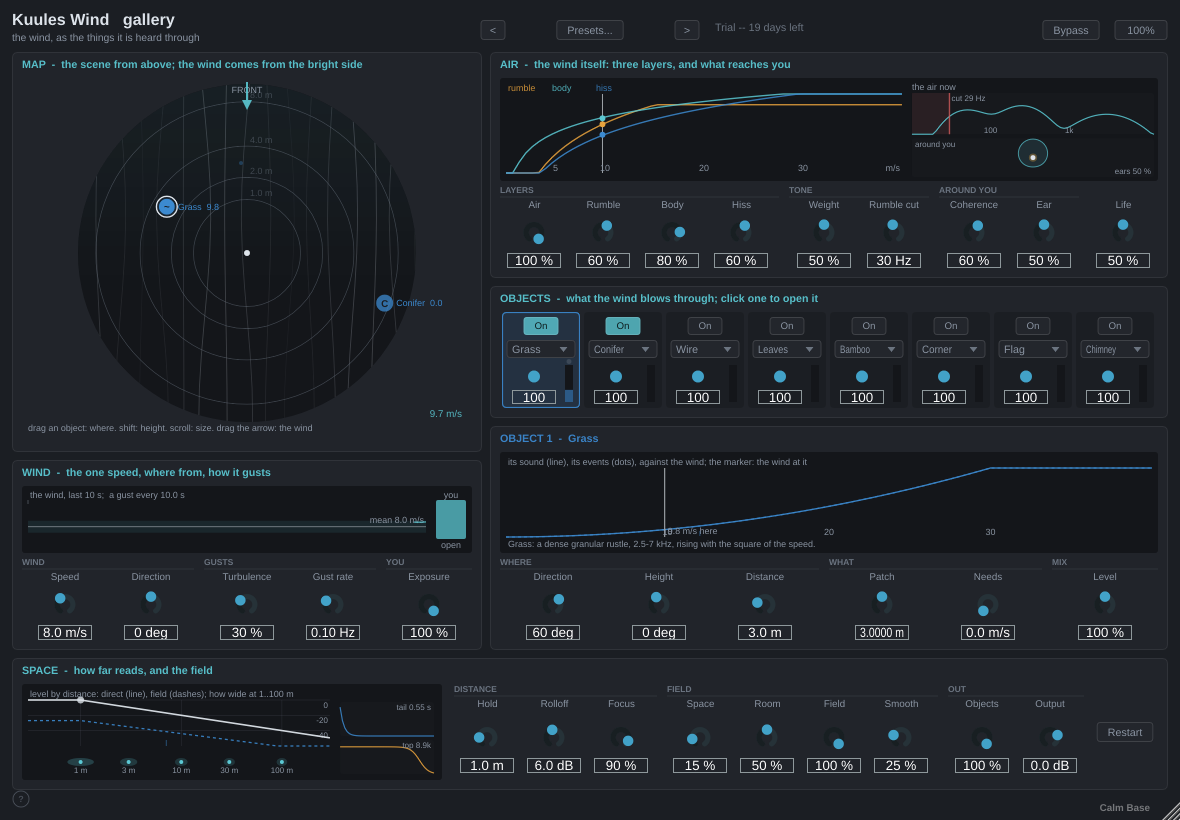
grass on one side, bamboo on the other
Wind is not a sound. It is what it does to things — grass, a crown of leaves, a wire, a gap in a wall, a flag, a chimney. Kuules Wind is a scene of those objects, placed around you, each blown by one wind with one speed and one direction. Built from a thesis on adaptive wind for interactive media, and from the physics under it.
The gust reaches the far trees first. A front travels with the wind: the objects upwind of you read it before you do, the ones downwind after. That delay is the direction cue no filter can give, and it is free. The air is three layers — rumble, body, hiss — each with its own law of the speed, so a gale is not a louder breeze: it hisses where a breeze cannot.
Grass, broadleaf, conifer, bamboo, dry leaves; a wire that sings its Strouhal pitch, a gap that whistles only when the wind is strong enough, a building corner, a flag, creaking wood, a chimney, a loose window. Up to eight of them on the map.
Turbulence, gust rate, and exposure — step into shelter and the air dulls, the objects stay where they are.
The air as a bed at 2nd order, leaning to where the wind comes from; the objects as points at full order, up to 10th. You need both.
Open field, forest edge, bamboo grove, a harbour's rigging, an alley, a cabin in a storm, the coast at thirty metres a second, a breeze in the grass.
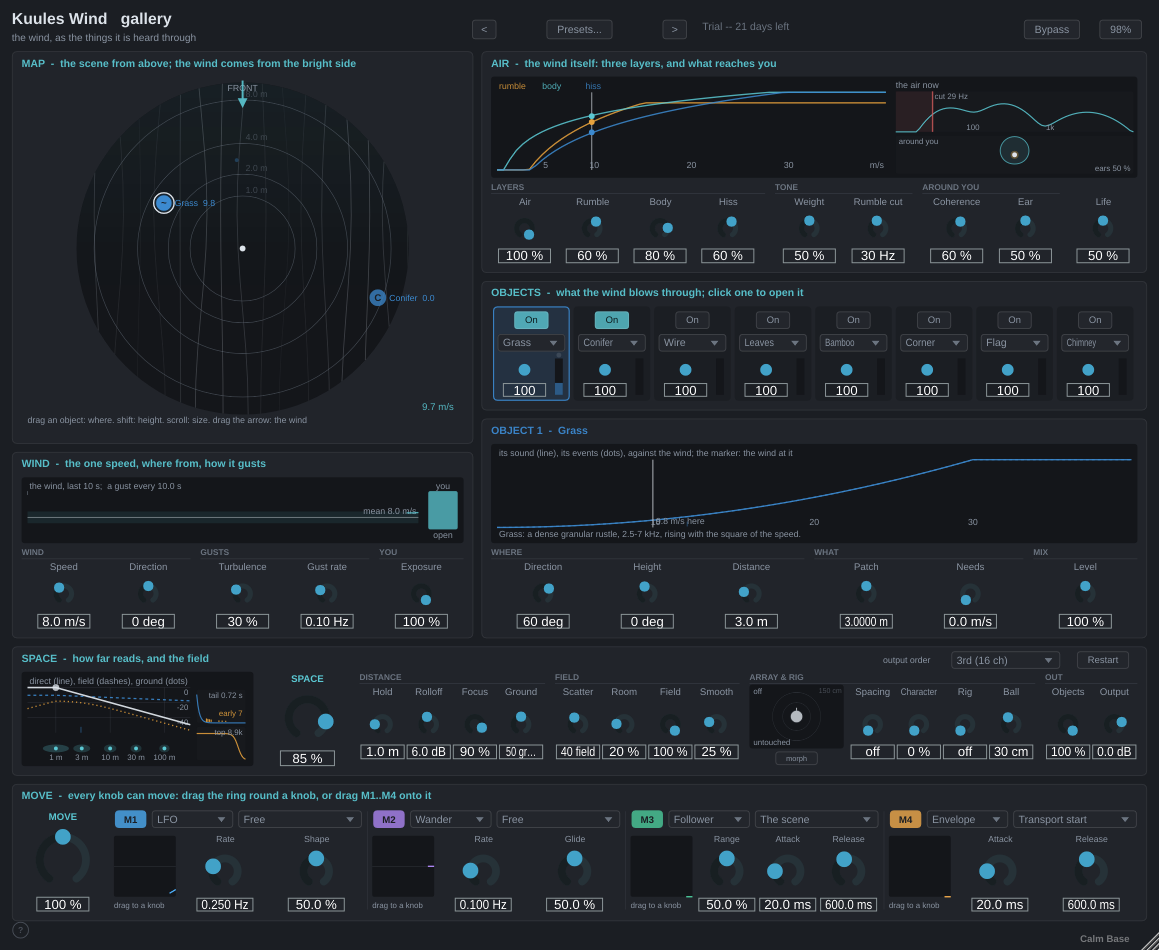
A ring round every knob: drag it, and the knob moves — by an LFO, a wandering drift, a follower of the track or of the scene itself, or an envelope. Four movers, a trace of each, and one MOVE knob for all of it. The knob stays where you set it; the ring shows the movement round it.
Spacing gives the scene a spaced pair's width — the low end of the ambience opens up, and every source gets a little more ITD — without moving a single direction (measured: 0.0 degrees at every octave). From 0 (off, the scene untouched) to 150 cm; Character adds the spaced capsules' own comb colour to the ambience only. Drawn from above, capsules and all.
Rig blends a dense sphere of omnis on a rigid ball — the rig you would build with 121 capsules round a baffle, stamped per capsule — into the sharp field: its time structure and shading in every direction and every order, with no comb and no aliasing, and the direction of every source untouched (measured). 0 is off; Ball sets its size (30 cm by default); Sum mixes the two, Morph blends a fraction of the ball's character. Drawn round the head, to scale.
Wide things are wide: a crown of leaves, a bonfire, a brook are many independent sounds across their width, not one blurred one — so a low-Space scene stays out in the world. Under every raised source, the ground's reflection (Ground: none, grass, stone). A few early reflections off what is round you, more and nearer with Scatter. And a cleaner field: dense from the first millisecond, no metallic ring, no rumble piling up when Room is up.