How it is made
Built from research. Tuned to real recordings. Checked on every change.
A generator that sounds like a river is a claim. This page is what stands behind it.
A generator that sounds like a river is a claim. This page is what stands behind it.
Every generator starts from how the real thing makes its sound, as the acoustics and physics literature describes it — not from a recording and not from a guess. Some of what that means in practice:
Among the work it builds on: Minnaert and van den Doel on bubbles; Tonolla and colleagues on river noise; Cetegen and Ahmed, Chadwick and James on flames; Prosperetti and Oguz on raindrops; de Langre and Moulia on plants in wind; Goller and Mindlin, Amador and Mindlin on birdsong; Madsen, Zimmer, Wisniewska and others on whales and dolphins; Essl and Cook, Schumacher and Woodhouse on bowed sound; McDermott and Simoncelli on how the ear hears textures.
Physics gets the sound into the right place. Recordings show how far it still is from the real thing. So each generator is held against recordings of what it makes — most of them from the BBC Sound Effects archive: for Water, 64 recordings of brooks, slow rivers, lake shores and drips; for Fire, the BBC’s recorded campfire, bonfire and wood fires; for Rain, rain on turf, leaves and roofs; for Underwater, about 110 recordings of reefs, whales, dolphins and surf heard from below; for Electric, 27 of hum, strip lights and welding.
The recordings are never used in the sound. They are measured — how bright, how steady or crackly, how fast it moves — and the plugin is measured the same way. Then the plugin’s own knobs are turned, by a program, until the two match as closely as the knobs allow. Whatever is left over tells us what no setting can fix, and that is the part of the engine we change.
Every time the code changes, every plugin is played through a set of fixed situations and measured again — automatically, before anything ships. We call these tests fences: each one marks a line the sound must not cross. There are about 140 of them across the suite, holding thousands of individual checks. A few of them, in plain words:
So yes: the plugins keep being measured. Not once before release, but on every change, for as long as they are developed.
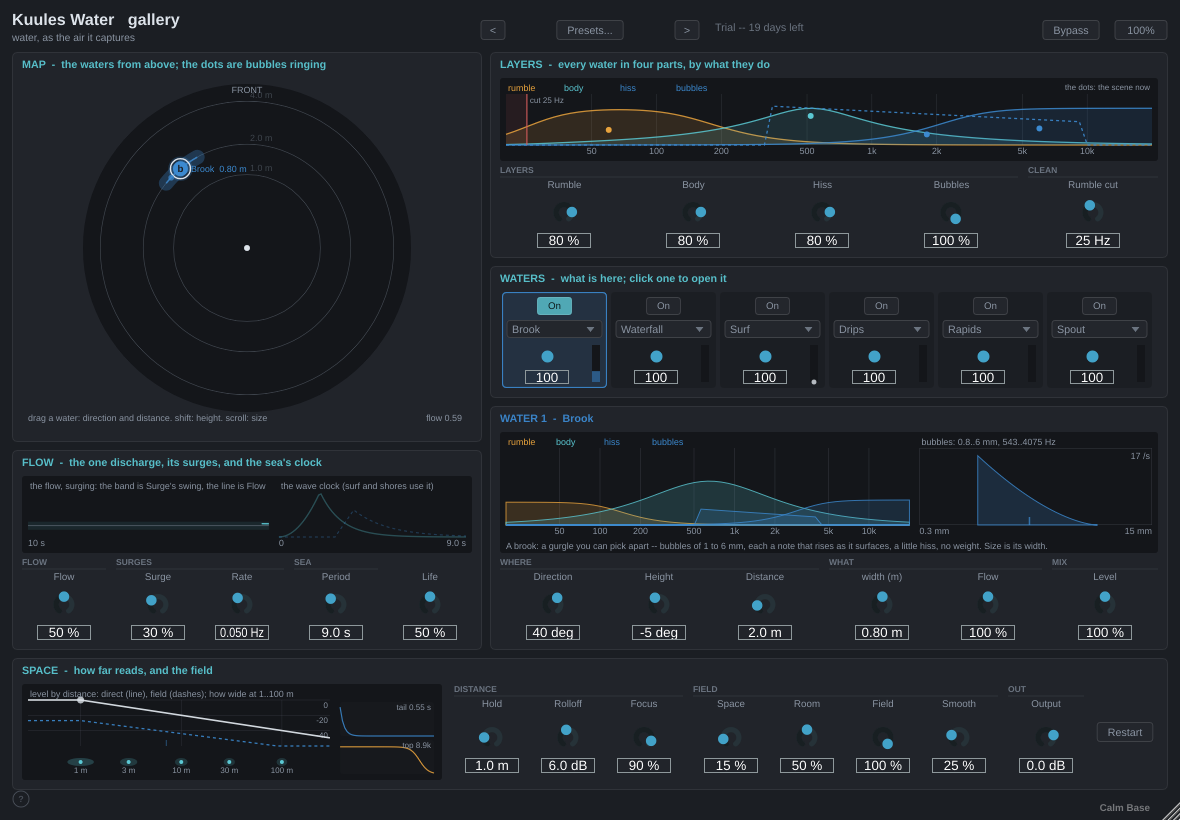
None of this shows in a screenshot. A waterfall that sounds like a waterfall is easy to promise. That it was built from how falling water makes its sound, held against real waterfalls, changed where the measurements said and left alone where they did not, and checked again every time anything changes — that is the work. It is why the sounds hold up when you move them, place them far away, or listen at 10th order, where a sound made by ear tends to come apart.